

In a chemistry equilibrium question, how do you decide whether a mixture will produce more product or more reactant? Start by comparing the reaction quotient Q with the equilibrium constant K. Knowing that K is large is not enough to predict the direction from every possible mixture.
This Canadian Chemistry Olympiad preparation guide uses an original calculation to practise that decision, build a concentration-change table and check what happens when conditions change. It is suitable for students who have studied balanced equations, molar concentration and equilibrium expressions.
Can you calculate an equilibrium expression but struggle to explain the next step? Try the example below, then scan the QR code to contact Hanlin. Send CCO EQUILIBRIUM with your grade, current chemistry course and target competition or stage to discuss your preparation questions.
1. Q describes the current mixture; K describes equilibrium
For a fixed reaction and temperature, K gives the equilibrium value of the reaction quotient. Q uses the same expression but is calculated from the mixture's current composition, which need not be at equilibrium.
- Q < K: the net reaction proceeds towards products.
- Q > K: the net reaction proceeds towards reactants.
- Q = K: the mixture is at equilibrium.
At equilibrium, forward and reverse reactions continue at equal rates. Their concentrations need not be equal. For background on the expressions, see OpenStax's equilibrium constants chapter.
2. Original exercise: calculate Q before solving for equilibrium
Consider the idealised gas-phase equilibrium:
H2(g) + I2(g) ⇌ 2HI(g)
At a fixed temperature, use the given practice value Kc = 64.0. In a closed vessel of fixed volume, the initial concentrations are [H2] = [I2] = [HI] = 0.10 mol/L. Use the concentration-based ideal model throughout.
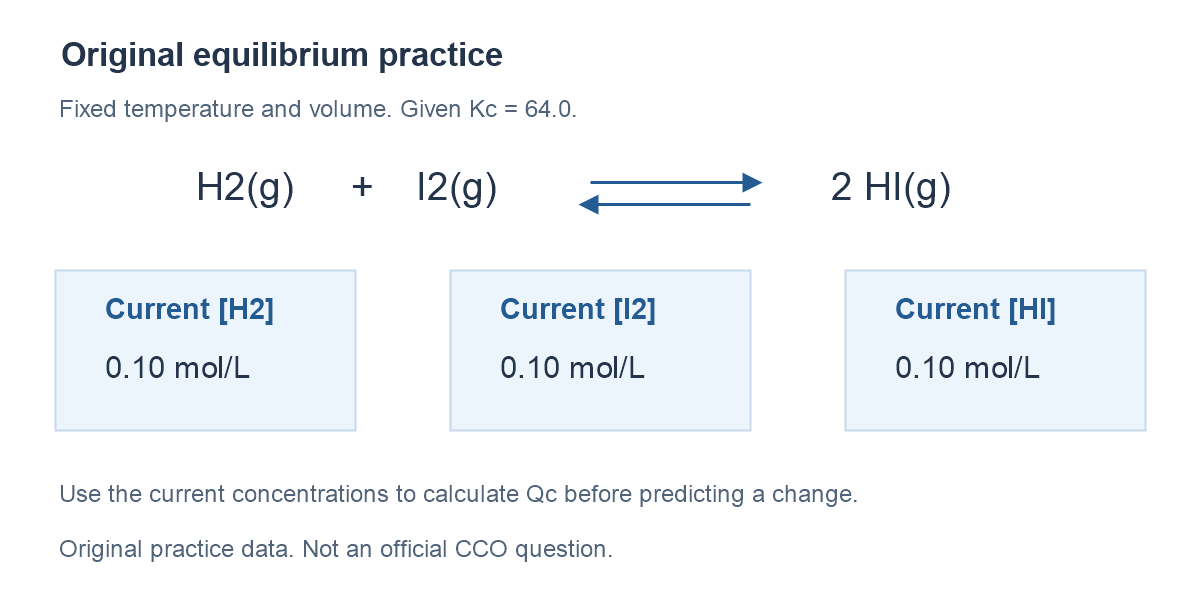
- Predict the direction of the net reaction.
- Find the equilibrium concentration of each species.
- Check your result using the equilibrium expression.
Try independently before reading on. This is a concept exercise, not an official question, a reference value for a laboratory experiment or a benchmark of CCO difficulty.
3. Write the expression from the balanced equation
The coefficient 2 on HI becomes an exponent. Using the current molar concentrations:
Qc = [HI]2/([H2][I2])
Qc = 0.102/(0.10 × 0.10) = 1.00
Since 1.00 < 64.0, the mixture undergoes a net forward reaction: hydrogen and iodine are consumed, and HI is formed. Equal initial concentrations do not make this an equilibrium mixture.
4. Build an initial-change-equilibrium table
Let x mol/L of H2 be consumed as the mixture approaches equilibrium. The equation requires the same concentration decrease for I2 and twice that increase for HI.
| Species | Initial | Change | Equilibrium |
|---|---|---|---|
| H2 | 0.10 | -x | 0.10 - x |
| I2 | 0.10 | -x | 0.10 - x |
| HI | 0.10 | +2x | 0.10 + 2x |
All entries are concentrations in mol/L. At equilibrium, substitute these expressions into Kc:
(0.10 + 2x)2/(0.10 - x)2 = 64.0.
The concentrations must remain positive, so 0 < x < 0.10. The ratio (0.10 + 2x)/(0.10 - x) is therefore positive. Taking the positive square root gives:
0.10 + 2x = 8(0.10 - x)
10x = 0.70
x = 0.070 mol/L
Thus [H2] = [I2] = 0.030 mol/L and [HI] = 0.240 mol/L. The net change consumes 0.070 mol/L of each reactant and produces 0.140 mol/L of HI, matching the 1:1:2 coefficients.
If you solve the squared equation without checking the physical range, it also produces x = 0.15. That would give negative reactant concentrations, so it must be rejected. More calculation examples are available in OpenStax's equilibrium calculations chapter.
5. Check the answer before moving on
Substitute the final concentrations into the original expression:
Qc = 0.2402/(0.030 × 0.030) = 0.0576/0.0009 = 64.0.
This equals the given Kc. Both reactant concentrations decreased, the product concentration increased and all values are positive. These checks support both the calculation and its chemical interpretation.
6. What happens when the equilibrium mixture changes?
Start each case separately from the equilibrium mixture above. Keep the temperature fixed. Use the concentrations immediately after the stated change, before the mixture has reacted further.
| Change | New Qc | Prediction |
|---|---|---|
| Raise [H2] to 0.060 mol/L; initially leave the other concentrations unchanged | 0.2402/(0.060 × 0.030) = 32.0 | Q < K: net forward reaction |
| Raise [HI] to 0.480 mol/L; initially leave the reactant concentrations unchanged | 0.4802/(0.030 × 0.030) = 256 | Q > K: net reverse reaction |
| Halve the volume so all concentrations double | 0.4802/(0.060 × 0.060) = 64.0 | Q = K: no net shift in this ideal model |
In the compression case, both numerator and denominator are multiplied by four. This reaction has equal total gaseous coefficients on each side, so the concentration scaling cancels. A different balanced equation can give a different result.
A catalyst changes how quickly equilibrium is approached without changing K or the equilibrium composition at the same temperature. A temperature change requires reconsidering K; do not automatically retain 64.0. These distinctions are discussed in OpenStax's chapter on shifting equilibria.
Does a question become confusing when a condition changes? Keep your original Q calculation and concentration table. Scan and send CCO EQUILIBRIUM to discuss whether your next practice focus should be chemical interpretation, algebra or explaining assumptions.
7. Two short self-checks
Question 1: From the equilibrium mixture, remove HI until its concentration is 0.120 mol/L, initially leaving [H2] and [I2] at 0.030 mol/L. Predict the net reaction direction.
Answer: Qc = 0.1202/(0.030 × 0.030) = 16.0. Since Q < 64.0, the net reaction proceeds towards HI.
Question 2: Instead, double the volume of the original equilibrium mixture at the same temperature. Does the equilibrium shift in this ideal model?
Answer: All concentrations halve: [H2] = [I2] = 0.015 mol/L and [HI] = 0.120 mol/L. Qc = 0.1202/(0.015 × 0.015) = 64.0, so there is no net shift.
8. Connect the exercise to your CCO preparation
For the next equilibrium problem, write the balanced equation, identify the phases, choose the correct expression, compare Q with K, track changes and substitute the result back. Distinguish initial concentrations from equilibrium concentrations throughout.
Check the specific pathway you intend to enter. The Canadian CCO programme website describes training for Canadian high-school students; the Canadian Chemistry Contest page is a separate information source. Confirm your eligibility, region, stage and current arrangements with the relevant organiser before choosing a preparation plan.
For a broader starting point, read our Canadian Chemistry Olympiad preparation guide. If mole ratios are still difficult, revisit our limiting-reactant exercise before moving to more complex calculations.
Discuss your Canadian Chemistry Olympiad preparation with Hanlin
Considering CCO preparation, or already studying and unsure how to improve? Scan the QR code below to contact Hanlin on WeChat. Send CCO EQUILIBRIUM with your grade, current chemistry course, region and target competition or stage.
You can share one practice problem and your own working to help focus the discussion. If your entry pathway is not yet confirmed, tell us what you have studied and what you would like help with.

Reading on your phone? Use the button above to open our WeChat contact link.